All the way down.
The dig from the front page, slowed down: one basketball through every layer, with values read out of the running world and the actual instructions the chip runs. Each layer links to the exact lines that do the work, and every line of the system is here to read.
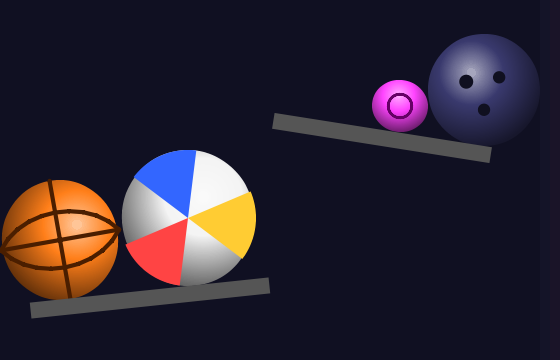
The table is an app, and an app is just a box that carries its own language. This one speaks physics:
gravity 140
friction 985
restitution average
walls bounce
pair Ball Shelf sweep
pair Ball Ball circle
Glass decides which box is under the pointer and draws the halo around it. Drag a handle and the change is written back into the ball’s own bindings.
The basketball is a 60×60 box at x −105, y −69, inside table.
Every device is a stream. The pointer arrives as mouseX, mouseY and mouseDown, and the ball reads them like any other value. The network will arrive the same way.
| r | 30 |
| mass | 6 |
| color | #FF7F1A |
| fx | −26902 |
| fy | −17834 |
| x | −105 |
| sq | 98 |
| still | 9383 |
The basketball is an object with slots. It is a clone of Basketball, which is a clone of Ball, which is a clone of Box. No classes, just prototypes.
fx is its position in 1/256ths of a pixel. still counts the frames since it last moved: 9,383 of them.
Its shape slot becomes a list of marks: one ellipse, squashed a little along the last contact, and two stroked SVG paths for the seams.
(ellipse 0 0 30 29 #FF7F1A 985 -167)
(stroke #4A1E00 70 ((M 0 -1000)
  (C 620 -560 620 560 0 1000) …))
A port of Gezira turns those curves into pixel coverage, in fixed point.
x <- fx / 256 is not an assignment. It says what x is, and every frame the system makes it true again. When fx changes, x follows, then the ball’s position on screen.
Today a loop in Rose runs each object’s bindings in order. Handing them to the Flux engine, sorted by what each one depends on, is next.
bind = slotid ws '<' '-' ws rawexpr ';' -> bind
(x ks-div fx 256)The shape of a KScript program, its objects and their bindings, is a 27-line Azoth grammar, and this is the rule that matched the line. The text after the arrow is captured whole.
That text is then parsed by a hand-written expression parser in Lisp, about 170 lines. Moving expressions into the grammar is next, so all of KScript is defined in one place.
(st.i (ld.i t 176) 0
  (shl (/ (shr (ld.i (ld.i t 192) 0) 3) 256) 3))
Prima lowers the binding to a small IR, then straight to RISC‑V. Slot 24 is fx, at byte 192 of the object’s table; slot 22 is x, at byte 176.
Numbers carry a 3-bit tag, so the code shifts right to untag, divides, and shifts left to tag the result. 31 instructions, nothing hidden.
Thirty-two bits in memory. The hart fetches them, sees an arithmetic opcode with the multiply-divide extension, and divides register a1 by a0: −26902 ÷ 256 = −105. That is where the basketball is.